Thursday, April 5, 2012

Digital Citizens Unite!

So if you've been following my blog for the last four months I've been trying to connect past history to today's digital world. I've been doing this for my Digital Civilization class, a class at BYU that fulfills a general education requirement. It has been a pretty cool experience.

Half way through the semester we decided (well the teachers decided and we had to do it) to write a ebook that combines a bunch of ideas that have been developing over the semester. It was hard. We have a beta release of the book but it still needs a decent amount of work in order to be a good final draft.

We're having an event to present the ideas in the book on Wednesday, April 11, 2012 at 7 pm MST. If you're interested you should come. It's in 251 of the Tanner building on BYU's campus. If you don't live in Utah or are too lazy to get off the couch there will be live streaming available at digiciv.byu.edu.

I am part of the Arts chapter. I wrote some stuff that I thought was interesting. I put some of the ideas in recent blog posts.

We're presenting our ideas in the form of a poem with live and digital music, live and recorded dancing, and accompanying graphics. It sounds kind of weird. It is kind of weird. But it should be pretty good and it'll only be five minutes.

Each chapter of the book gets five minutes to present their ideas and these are the groups:


  • The Arts
  • Business
  • Education
  • Government
  • IP & CC
  • Inquiry
  • Openness
  • Science
  • Ebook Team
The order is yet to be determined. It should be fun and there will be refreshments afterwards.

Whether you come or not, I hope you've enjoyed reading my blog and maybe even learned something. 


Thursday, March 22, 2012

The Arts: One on One

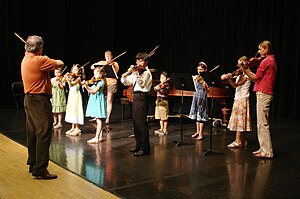
Many of the arts can be learned easily through the diverse outlets available through the digital age, whether it be Youtube, Adobe, Paint, Garage Band, or something else. An argument could be made that this means that traditional arts education is unnecessary but this is not true. 

The problem with these digital learning resources is that there is no feedback, no personal criticism, which is essential for learning. 

Tuesday, March 20, 2012

The Arts: An Annotated Bibliography

I tried to find people who were interested in the arts and especially with education. I used some regular Google searches, fiddling with different key words, to find groups that fit this category. These were my findings:


http://www.arteducators.org/
http://artsusa.org/networks/arts_education/default.asp
http://www.yea.org/
http://www.ijea.org/

I also thought about people I knew. Being a music minor, I have had contact with some professors in the music department. Here are a couple of them:

Luke Howard
Eric Hansen
Claudine Bigelow

I also did a search on Google+ in order to find thought leaders without much success. So I used the library to find a book and used that to find people.

Friday, March 16, 2012

Education: Promoted by The Arts

The arts are an important part of education. They foster creativity and help students to develop in many other areas. Some of these areas will be explored.

Creativity

The arts help students explore a skill that is not used that often in school, that of creativity. There is creative writing but that is about the extent of creativity in schools outside of the arts. There are only so many ways to do a math problem correctly. Some of these solutions may be more interesting than others but it is hard to call a math solution creative.

Thursday, March 8, 2012

KONY 2012

Yes, I am jumping on the KONY 2012 train.

If you haven't seen the video here it is:


The video is kinda long so I'll summarize it if you don't feel like watching it. Central Africa has a bunch of problems. One of them is that this guy named Joseph Kony kidnaps kids and makes the boys be soldiers and the girls be sex slaves in his army called the LRA. Also the movie maker's kid is pretty cute.

This isn't a new thing though. 

17th Century & The Arts

The 17th Century began the shift away from dependence on religion for the arts.

Composers started to develop their own styles. Instruments were being invented.  Pieces were written for only instruments, no vocal.  Opera was born in Florence out of an attempt to revive the music of Classical Greece.

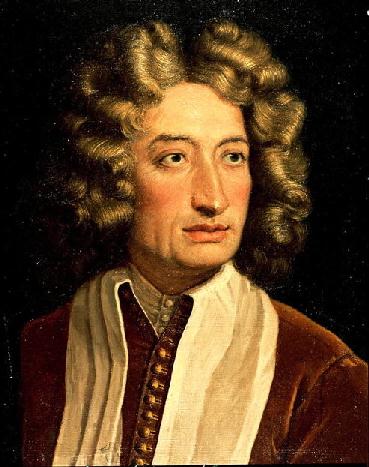
Arcangelo Corelli (17 February 1653 – 8 January 1713) was the first composer to make a career off selling printed music, free of church control and restriction.

There were academies of art (visual arts) through out Europe starting in Italy and France. 


Dance in the 17th Century was not that big of a factor in education. Louis XIV was a big fan of dance. He was the Sun King and the state of the court was perceived by the level of performance. Here’s a clip from the “The King is Dancing”:


This is pretty awesome.

Thursday, March 1, 2012

Control Theory

This is a little more about control theory with links to appropriate learning sources. As I said in class I work in IDeA Labs, a research lab in the computer science department.

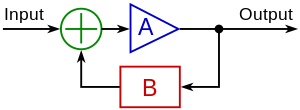
Control theory is mostly used in systems that have some sort of feedback. This theory was born out of electrical engineering so the original feedback systems that were modeled were electric circuits.
The theory is rich in mathematics with theorems and regulations for stability.